
Content marketing is now essential for any business trying to stand out online and build a recognisable brand, but knowing what content you should be creating and where you should be creating it to isn’t always obvious. In this blog we look to break down what content marketing is, why it’s important and the different types of content you can create.
- What is content marketing?
- Why is content marketing important?
- Benefits of content marketing
- Types of content marketing
- Choosing the right type of content
What is content marketing?
Content marketing is a long-term way of building awareness, trust and relationships with your audience through valuable, relevant content. It involves creating and sharing content across channels such as your website, blog, social media, email, video and digital PR to help people find, understand and connect with your brand. Done well, it can increase visibility, strengthen customer relationships and support business growth over time.
Like most aspects of marketing, content marketing has changed massively over the past year or so. AI has made it easier for businesses to create content, but as a result, the amount of content being published has increased massively online, making it more difficult to stay visible. As a result, a good content strategy has never been more important.
Why is content marketing important?
Without content, it’s difficult for your business to stay visible online, connect with potential customers and give people a reason to choose you. Content is the backbone of many marketing strategies, giving you a way to:
- Get your business in front of the right people: Create useful, relevant content that helps potential customers find your business when they’re searching for answers, ideas or solutions.
- Share your expertise: Use your knowledge and experience to answer questions, solve problems and give people genuinely useful information. This helps build trust and shows potential customers that you understand what you’re talking about.
- Give your business a personality: Content gives you a chance to show what your business is about, share your values and communicate in a way that feels authentic to your audience.
- Stay connected with your audience: Regular, helpful content gives people a reason to keep coming back to your website and keeps your business front of mind when they’re ready to buy.
When creating content, consider whether it offers something that other businesses can’t easily replicate. This could be first-hand experience, original insights, unique examples or specialist knowledge. This is known as non-commodity content.
To learn more, read our guide to non-commodity content for businesses.
Benefits of content marketing
Here are the main benefits of investing in a good content marketing strategy:
Increase your visibility across search, social and AI
Search engines are no longer the only way people discover businesses. Today’s buyers move between search engines, AI assistants, social media platforms, videos and online communities before making a decision.
Content marketing helps your business build visibility across these different channels. Publishing useful, relevant content gives potential customers more opportunities to discover your brand, understand what you offer and return to you when they need further information.
It can also support your wider search visibility by demonstrating your experience and expertise around the subjects that matter to your audience.
Build trust before someone is ready to buy
Most buyers do not convert the first time they encounter a business. They may research their problem, compare different approaches and return to several sources before deciding what to do next.
Content marketing allows you to demonstrate your expertise, answer common questions and provide useful information long before someone is ready to make a purchase.
Providing genuine value without immediately asking for something in return can help create familiarity and trust. When that person is ready to choose a product, service or provider, your business is more likely to be one of the options they consider.
Support every stage of the buyer journey
Different types of content can support people at different stages of their decision-making process.
Educational blog posts, videos and social content can help people understand a problem during the awareness stage. Guides, reports, webinars and podcasts can help them explore possible solutions during the consideration stage. Case studies, customer reviews, testimonials and product demonstrations can provide reassurance when they are ready to make a decision.
A strong content strategy ensures that you are not only attracting attention, but also providing the information people need as they move closer to becoming customers.
Strengthen your brand authority
Consistently publishing useful, expert-led content can help establish your business as a reliable source of information.
Content gives you an opportunity to demonstrate your understanding of the subjects, challenges and questions that matter to your customers. Over time, this can strengthen your reputation, differentiate your business from competitors and make people more likely to trust your recommendations.
Building authority does not mean publishing content for the sake of it. The focus should be on producing accurate, relevant content that reflects genuine knowledge and helps your audience make informed decisions.
Create more opportunities to generate leads
Content marketing can help introduce potential customers to your business and encourage them to take the next step.
A useful blog post might lead someone to download a guide. A research report might encourage them to subscribe to a newsletter. A case study or assessment tool might prompt them to request a quote or contact your team.
Calls to action can be included throughout your content to guide visitors towards an appropriate next step. The action should reflect the reader’s needs and their stage of the buyer journey, rather than pushing every visitor directly towards a sale.
Improve the performance of other marketing channels
Content marketing rarely works in isolation. Blog posts, videos, guides, research reports and customer stories can support SEO, social media, email marketing, digital PR and paid advertising.
For example, an original research report can generate material for several blog posts, social updates, email campaigns, press releases and videos. A customer case study can support sales activity, website content, social proof and remarketing campaigns.
Creating high-quality core content gives your business a bank of assets that can be adapted and repurposed across multiple channels, helping you gain more value from the work you produce.
Deliver long-term value
Some marketing activities stop producing results when the associated spend ends. High-quality content, however, can continue attracting visitors, generating engagement and supporting leads after it has been published.
A helpful guide, article or video can remain valuable provided it is regularly reviewed and updated. This makes content marketing a long-term investment rather than a one-off campaign.
Content still requires time, budget and expertise, but creating useful evergreen assets and repurposing them effectively can extend their value and improve the return on that investment.
Types of content marketing
Content marketing can take many forms. The most appropriate formats for your business will depend on your audience, objectives, available resources and the channels your customers use.
The following content types have been grouped into written, visual, audio, social, interactive and owned-audience content.
1. Written content
Blog marketing:
Blogs are an effective form of inbound content because they give businesses plenty of flexibility in terms of purpose and subject.
A business can use blog content to answer customer questions, explore relevant industry topics, explain products or services and share practical advice. Blog posts can also link to related resources, include calls to action and support the wider structure of a website.
When creating blog content:
- Focus on subjects that are relevant and useful to your audience.
- Demonstrate your expertise and include first-hand experience where possible.
- Build topical authority by covering related subjects in useful depth.
- Write for people first, rather than simply targeting keywords.
- Link to useful supporting content.
- Include a clear, relevant next step.
- Review and update older articles to keep them accurate and useful.
Guides, how-to content and checklists:
How-to guides help potential and existing customers understand a subject, complete a task or solve a specific problem. They can range from short step-by-step articles to more detailed guides, tutorials and learning resources.
Checklists offer a simple, practical way to break a process into manageable steps, giving readers something they can save and refer back to. For instance, we included the checklist below in our ‘How to Choose a UK Local SEO Agency” blog, so readers could navigate away from our website, but still retain the framework we talked about within the blog.
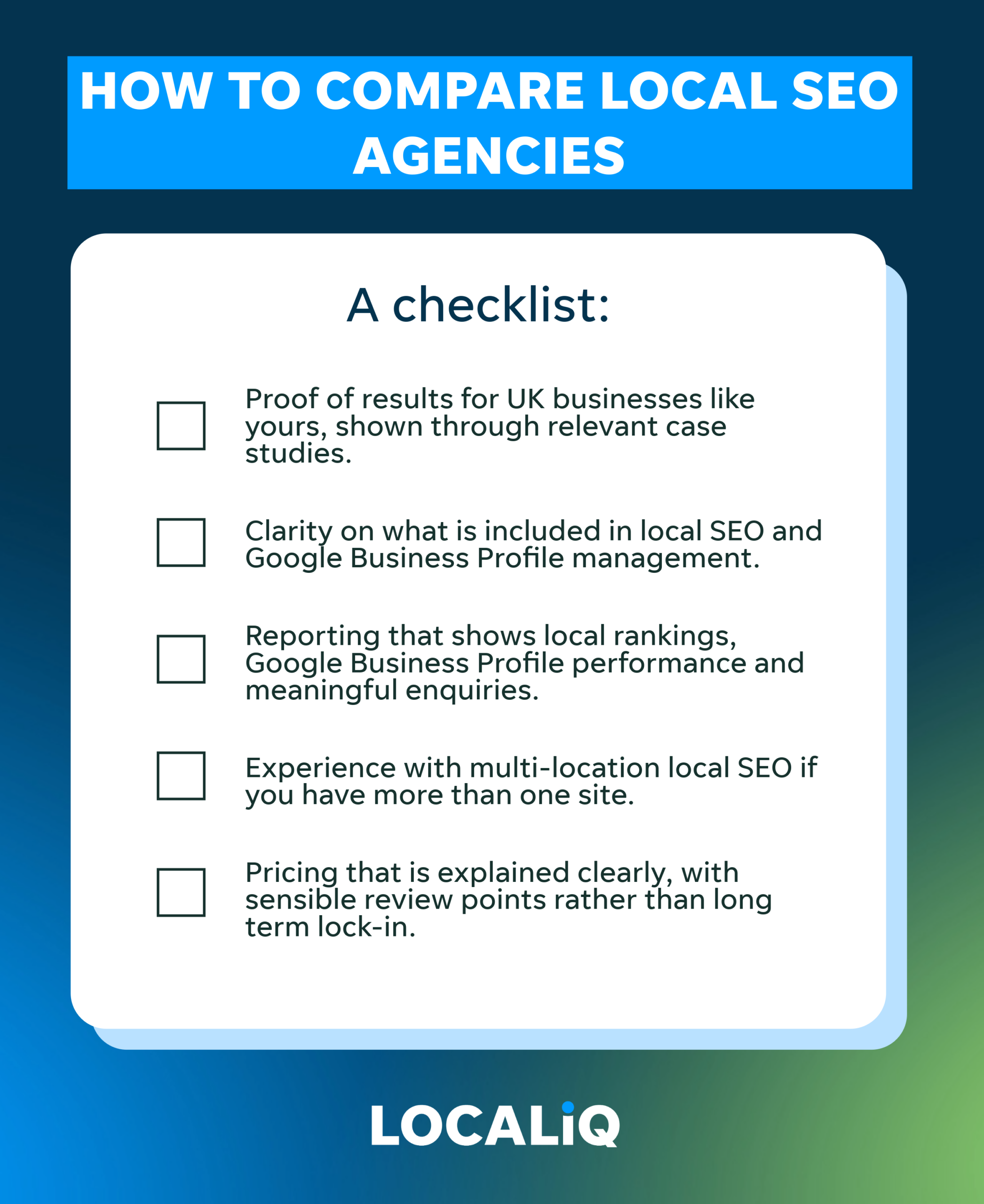
When creating guides and checklists:
- Focus on a specific audience need or problem.
- Keep the format and length appropriate to the subject and platform.
- Break complex information into clear, manageable steps.
- Include practical examples and first-hand advice where useful.
- Show how your product or service could fit into the reader’s existing processes, where relevant.
- Consider how the content could be adapted for social platforms to reach a wider audience.
Case studies:
Case studies are useful for potential customers who want to understand how a business has supported people or organisations with needs similar to their own.
They can show a customer’s journey from the initial challenge through to the solution and resulting outcomes. This allows prospective customers to see a product or service being used in a realistic context.
A strong case study should provide enough detail to be credible without becoming unnecessarily complicated. Where possible, it should include:
- The customer’s original challenge.
- The approach or solution provided.
- Evidence of the outcome.
- Direct customer feedback.
- Relevant data or measurable results.
You can see examples of case studies here.
Research reports, whitepapers and eBooks:
Original research and data-led content can provide a stronger foundation for content marketing by offering insights that cannot be found elsewhere. Industry surveys, benchmark studies, annual reports and analysis of proprietary data can help businesses identify trends, demonstrate expertise and give audiences useful evidence to inform their decisions.
Original findings can also support wider marketing activity. Research-led content can form the basis of thought leadership, provide data and commentary for digital PR campaigns, and create opportunities for journalists and other publishers to reference or link to the original source. Publishing distinctive, well-supported findings can also strengthen a brand’s visibility across search and AI-powered discovery platforms, particularly when the content provides clear evidence, context and genuinely useful insights.
The most effective research-led content starts with a clear question or objective and presents the methodology, findings and implications transparently. This helps establish credibility while giving the resulting content value beyond its role as a promotional asset.
2. Visual content
Video content marketing:
Video can help businesses explain information in an engaging and accessible way. It can be used to demonstrate products, answer questions, share customer experiences and introduce the people behind a business.
Video content can be published on websites, landing pages, social media channels, video platforms and within email campaigns.
The most appropriate format will depend on the purpose of the content. A short social video may be designed to attract attention, while a longer explainer or product demonstration can help someone evaluate a solution in more detail.
Short-form video on platforms such as TikTok, Instagram Reels, YouTube Shorts and LinkedIn can support discovery, education and brand personality. However, short-form content should still have a clear purpose and provide something useful or relevant to the intended audience.
Educational video can include tutorials, explainers, product demonstrations and answers to common customer questions. These formats can help businesses make complex information easier to understand and address the questions audiences are likely to have.
Webinars and live video can be used for live Q&As, expert panels, interviews and product demonstrations. Recorded sessions can also be repurposed into shorter videos and other content, helping businesses get more value from the original session.
Here is an example of a LOCALiQ webinar that was originally hosted live and then uploaded to YouTube after the event:
Infographic content marketing:
Infographics present facts, statistics and other information in a visual format.
They can make a complex process or data-heavy subject easier to understand by combining concise copy with clear imagery. They are particularly useful when the audience would benefit from seeing comparisons, stages, relationships or trends visually.
Infographics can be used within blog posts, reports, social media content, presentations and digital PR campaigns.
The information still needs to be accurate, clearly sourced and easy to interpret. It’s easy to get caught up in the visual aspect of infographics, but the information presented still needs to be easy to understand and digest.
3. Audio content
Podcast content marketing:
Podcasts give businesses the opportunity to explore subjects through interviews, discussions, storytelling and expert commentary.
Businesses have control over the podcast’s subject, guests, episode length, publishing schedule and promotional approach. This makes podcasts a flexible format for thought leadership and ongoing audience engagement.
However, a podcast should have a clear purpose and a realistic publishing plan. Its subject and format should reflect the questions and interests of the intended audience.
A lot of businesses will film the recording of their podcasts. This provides extra video content that can be distributed across other channels, with shorter clips encouraging viewers to listen to the full podcast.
4. Social and community content
Social Media Content Marketing:
Social media provides businesses with a direct way to reach and interact with their audiences. It can be used to distribute information, start conversations and bring people back to content on a business’s website or other platforms.
Social content can include written posts, images, short and long-form video, stories, polls, live sessions and document-style posts. Businesses can use these formats to share expertise, answer questions, comment on industry developments, showcase customer experiences and give audiences a better sense of the people behind the business.
The most effective approach will depend on the audience and the platform. Businesses do not need to create the same content for every channel; content can be adapted to suit how people use each platform and what they expect to find there.
Employee advocacy can also extend the reach of social content. Employees and internal experts can share company content, knowledge and commentary through their own professional networks, adding a more personal perspective to the business’s social presence.
User-generated content:
User-generated content is content created by customers, followers or other members of a brand’s audience.
It can include customer photographs, videos, social posts and other content featuring a product, service or experience.
Because it comes from real customers, this type of content can show how people use and experience a brand in real life. It can also encourage others to get involved and contribute their own content.
Businesses should get permission before republishing customer content and credit the original creator.
Reviews and testimonials:
Testimonials and customer reviews provide evidence from people who have used a business’s products or services.
They can help prospective customers understand what makes a business different and offer reassurance during the decision-making process.
Reviews are often published on external platforms, while testimonials may be selected and presented by the business on its website or marketing materials. Both can provide valuable social proof, but they should be genuine, specific and presented accurately.
Reviews and testimonials can be incorporated into:
- Service pages
- Case studies
- Social media posts
- Email campaigns
- Landing pages
- Sales materials
5. Owned-audience content
Email newsletters:
Email newsletters allow businesses to communicate directly with an audience that has chosen to hear from them. They can include curated advice, company updates, industry commentary, customer stories and links to other useful content.
Newsletters should give readers a clear reason to subscribe and provide value beyond generic sales messages. Promotions can be included, but they should be balanced with useful and relevant information.
Choosing the right content type for your marketing goals
There is no single content format that will be right for every business. The best approach is to choose content that aligns with your objectives, audience and available resources.
Different content formats naturally lend themselves to different goals, which is why most successful content strategies use a mix of content types rather than relying on a single format.
Reaching new audiences
If your goal is to increase visibility and reach people who may not already be familiar with your business, focus on content that is easy to discover and share.
Suitable formats include:
- Blog posts
- Educational videos
- Podcasts
- Social media content
- Infographics
Demonstrating expertise
If you want to showcase your knowledge and position your business as a trusted source of information, focus on content that provides depth, insight and practical value.
Suitable formats include:
- Detailed guides
- Research reports
- Whitepapers and eBooks
- Webinars
- Expert interviews
- Original research and data-led content
Helping buyers make informed decisions
Many buyers want to see proof before committing to a product or service. Content that demonstrates experience, results and customer outcomes can help build confidence and reduce uncertainty.
Suitable formats include:
- Case studies
- Testimonials
- Customer reviews
- Product demonstrations
- Comparison content
- Consultations or audits
Generating leads and enquiries
Some content formats are particularly effective at encouraging potential customers to take the next step, whether that’s subscribing to a newsletter, downloading a resource or requesting a consultation.
Suitable formats include:
- Research reports
- Downloadable guides
- Webinars
- Assessment tools
- Calculators
- Templates and resources
- Email newsletters
Supporting existing customers
Content marketing shouldn’t stop once someone becomes a customer. Ongoing educational and support-focused content can help customers get more value from your products or services while strengthening long-term relationships.
Suitable formats include:
- Email newsletters
- Educational guides
- Tutorials
- Webinars
- Customer stories
- Product updates
- Community content
Most businesses will benefit from using several types of content rather than focusing on just one. For example, a research report might help demonstrate expertise, generate leads and create content for social media, while a customer case study might support both trust-building and sales activity.
The most effective content strategy is one that supports your wider business goals while helping your audience find the information they need, when they need it.
Final thoughts
Content marketing can take many forms, from blogs, guides and videos to research reports, podcasts, newsletters and interactive tools. Not every business needs to invest in every content type. The right mix depends on your goals, audience, expertise and available resources.
Start by identifying what your audience needs and what you want your content to achieve. From there, choose the formats that help you communicate that information effectively and distribute it through the channels your audience already uses.
Need help developing your content strategy? Contact us today to find out more about our content marketing and video marketing services.
Content marketing FAQs
What are the main types of content marketing?
Some of the most common types of content marketing include blog posts, guides, case studies, videos, podcasts, social media content, research reports, whitepapers, newsletters and interactive tools. The right mix will depend on your goals, audience and resources.
What is the most effective type of content marketing?
There is no single content type that is most effective for every business. Blog content can support search visibility, videos can improve engagement, and case studies can help build trust. The best results often come from combining multiple formats as part of a broader content strategy.
Which content marketing formats are best for lead generation?
Content that offers clear value in exchange for an action is often effective for lead generation. This can include guides, research reports, webinars, assessment tools, calculators, templates and email newsletters.
What content should I create if I have a small budget?
Businesses with limited resources should focus on creating high-quality content that can be repurposed across multiple channels. Blog posts, customer case studies, email newsletters and short-form videos are often good starting points because they can support several marketing activities at once.
How often should I publish content?
Consistency is more important than volume. It’s better to publish high-quality content on a sustainable schedule than produce large amounts of content that provide little value. The ideal frequency will depend on your resources and audience expectations.
What’s the difference between content marketing and social media marketing?
Content marketing is the creation and distribution of valuable content to attract and engage an audience. Social media marketing is one of the channels used to distribute that content. A content marketing strategy may include blogs, videos, reports and newsletters, while social media helps amplify and promote those assets.
Is content marketing still effective in 2026?
Yes. While the channels people use to discover information continue to evolve, businesses still need valuable content to attract audiences, build trust and support customer decisions. Content also plays an important role in search visibility, AI-powered discovery experiences, social media and email marketing.
How long does content marketing take to deliver results?
Content marketing is generally a long-term strategy. Some formats, such as social media content and email campaigns, can generate engagement quickly, while SEO-focused content, research reports and authority-building content may take longer to deliver measurable results.
What content works best at each stage of the buyer journey?
Awareness-stage audiences often engage with blogs, videos, podcasts and social content. Consideration-stage audiences may be looking for guides, reports, webinars and expert advice. Decision-stage audiences typically need case studies, testimonials, reviews and product demonstrations to help them make a confident choice.
How do I choose the right content type for my business?
Start by defining your goals, audience and available resources. Then consider where your audience is in the buyer journey and what information they need. The best content format is one that helps your audience while supporting a clear business objective.

Related Articles

A Complete Guide to Social Media Advertising for UK Businesses

Dates for your 2026 Social Media Calendar (with Download)

Which Social Media Channels Are Best For Your Business In 2025?
A Step-by-Step Guide to Setting Up Facebook Automotive Inventory Ads for UK Car Dealerships

How to Get Your Social Media Accounts Verified