On-page SEO (search engine optimisation) is a great place to start when trying to improve your visibility across search engines such as Google and Bing, as well as AI-powered search tools like ChatGPT and Perplexity.
As AI-driven search becomes more prominent, optimising your website’s content and structure is more important than ever. SEO should be a key focus for your business if you’re looking to generate long-term, sustainable growth across these search platforms. In this blog, we’ll walk through all the essential components of a successful on-page SEO strategy, built for both traditional search methods and the new era of AI-based discovery.
This blog will cover:
- What is on-page SEO?
- Why is on-page SEO important?
- On-page and off-page SEO: What’s the difference?
- 12 on-page SEO strategies for your website
- Creating helpful content
- Optimising meta tags
- Utilising header tags
- Optimising URL structure
- Internal linking
- Optimising images
- Improving page load speed
- Improving mobile-friendliness
- Improving user experience (UX)
- Using structured data
- Integrating social sharing features
- Analysing on-page SEO performance
- On-page SEO: FAQ
What is on-page SEO?
Traditionally, on-page SEO is the process of optimising individual web pages to rank higher on search engine results pages (SERPs). These days on-page SEO methods are also used to ensure that web pages are contending for visibility across AI-powered search results too. The goal is to ensure web pages are understandable and relevant to search engines, AI agents and humans alike.
This involves various key elements such as content, page structure, meta descriptions and titles, and internal linking, all of which contribute to a page’s visibility and ranking potential. Unlike off-page SEO, which deals with external signals like backlinks, on-page SEO is entirely within your control. By focusing on on-page factors, businesses can create a strong foundation for their SEO efforts.

Prepare for SEO take off 🚀
Take the first step to ranking higher with our free SEO audit.
Get a complete overview of optimisation opportunities and uncover the actions you need to take to scale the SERPs.

Why is on-page SEO important?
On-page SEO is important (particularly for businesses) because it increases the likelihood that potential customers will find your website when searching for relevant products or services. As AI‑powered search continues to evolve, well‑structured, high‑quality content has become even more important for visibility.
To stay competitive online, businesses need a strong and consistently updated on-page SEO strategy that helps them stand out from competitors.
For instance, imagine an online furniture store that created a “dining tables” page five years ago and hasn’t touched it since. That page is far less likely to rank well compared with a competitor who regularly updates their dining table content and has created additional, more specific pages for each category they offer. Fresh, organised, and relevant content signals to search engines and including AI-driven search platforms that your website is more useful and up to date.
It’s important to note that on-page SEO is an ongoing process. Unlike paid search campaigns, which can be switched on and off, SEO doesn’t have a fixed end date. To achieve long-term results, businesses should regularly review their pages, refresh content, and make improvements as search behaviour and AI‑driven discovery continue to evolve.
How AI-powered search is changing on-page SEO
With recent advances in AI-powered search, on-page SEO now plays a key role in how both users and AI understand your content.
In the past, Google mainly showed a list of website links. Today, it often displays AI-generated summaries and rich results before you even click. This means users can get answers directly on the search results page, without necessarily visiting multiple websites.
For UK businesses, this changes the role of on-page SEO. It’s no longer just about ranking in the traditional listings, it’s about creating clear, well-structured content that search engines can easily understand, summarise and reference. Businesses that provide comprehensive, trustworthy answers to real customer questions are more likely to gain visibility, whether through standard rankings, featured snippets or AI-powered results.
On-page vs off-page SEO: what’s the difference?
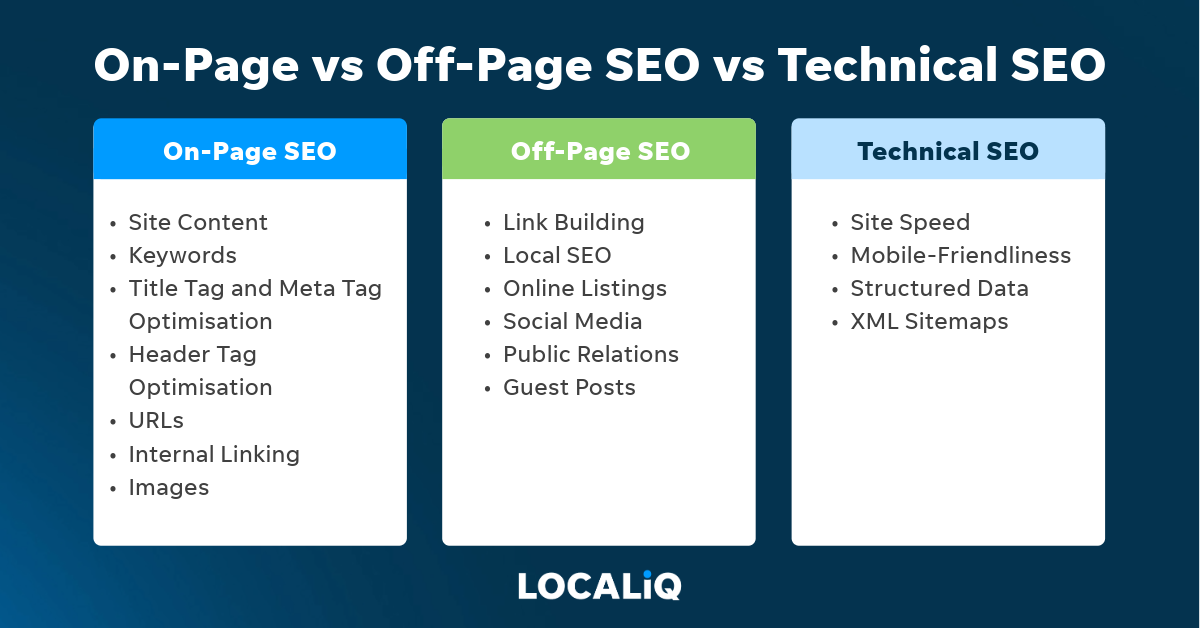
Whilst on-page SEO focuses on actions that can be carried out on your website, off-page is a series of actions that are conducted off-site to improve search ranking and generate traffic back to your website. Backlinks are considered to be the most important and valuable component of off-page SEO, but other tactics include social media and online listing optimisation.
12 On-page SEO strategies for your website
1. Create high-quality, helpful content for both users and AI
Content is at the heart of on-page SEO. Search engines like Google prioritise high-quality, relevant content that satisfies user intent.
Now that AI-powered search has become the norm, it’s become more difficult for businesses to maintain visibility across the SERPs.
AI likes to surface “unique” information it can display, so try to use case studies, first-hand examples, quotes, and, where possible your own data. This helps boost the credibility of your content and back it up with real facts and figures.
How to ensure your content is SEO-friendly:
- Conduct keyword research: Identifying and incorporating relevant keywords is essential. Keyword research is the process of identifying terms and phrases that potential customers are likely to use when searching for products or services related to your business. Tools like Google Keyword Planner, Ahrefs, and SEMrush can help you identify high-traffic keywords with manageable competition levels.It’s also important to focus on using your keywords within natural-language questions, not just single phrases, so both search results and AI summaries can match your content to real queries. Consider using FAQs or Q&A-style formatting where appropriate.If you’re not sure where to start, we’ve got a handy step-by-step guide to talk you through the basics of keyword research.
- Ensure your content is relevant: Content should be highly relevant to the target audience. This means understanding their needs, preferences, and search behaviour. Creating buyer personas can help businesses tailor their content to target specific audience segments, and identify real questions that those audience segments may have.
- Structure your on-page content correctly: Well-structured content is easier for search engines to index and understand. This includes using headings (H1, H2, H3) to organise content, breaking text into short paragraphs, and incorporating bullet points where necessary to improve readability, which also makes it easier for AI to extract concise snippets when generating overviews or summaries.<br />
- Make sure your content is original: Search engines penalise duplicate content, and AI tools are less likely to feature generic articles in their answers. Businesses should strive to produce original content that offers unique value, such as first-hand experience, local examples and proprietary data, which not only helps in SEO but can also help establish your business as a thought leader in its industry.
Top tip for local businesses: AI and local SEO
When a user conducts a local search (e.g. “plumber near me”), AI-generated results often surface a mix of maps, business profiles and summary content, so you should make sure that your on-page details like opening hours, locations, and services are consistent with your Google Business Profile and local citations.
2. Optimise your meta tags
Meta tags, including the title tag and meta description, play a critical role in on-page SEO. These elements provide search engines and users with information about the content of a web page.
- Title tag: The title tag is one of the most important on-page SEO elements. It should be descriptive, include the primary keyword, and typically stay within roughly 50–60 characters to maximise the chance it displays fully in search results. A compelling title tag can improve user engagement and help you win a greater share of clicks from the impressions you do receive.
- Meta description: While not a direct ranking factor, the meta description can strongly influence how many users choose your result if browsing search results in a more traditional manner. It should provide a concise summary of the page content, incorporate relevant keywords for users, and usually sit in the 120–160 character range so it is less likely to be truncated. A well-crafted meta description can help your listing stand out and capture a larger share of the remaining clicks in increasingly zero-click, AI-enhanced search results.
3. Correctly utilise header tags
Header tags (H1, H2, H3, etc.) are used to organise content and make it easier for users and search engines to understand.
The H1 tag should include the primary keyword and clearly indicate the main topic of the page. Subsequent header tags (H2, H3, etc.) should be used to structure the content into logical sections, each covering subtopics related to the main topic.
This hierarchical structure helps search engines understand the importance of different sections of your content and improves overall readability.
4. Enhance your URL structure
A clean, descriptive URL structure is beneficial for both SEO and user experience. URLs should be concise, include relevant keywords, and reflect the page’s content. Avoid using complex strings of numbers or unnecessary characters. For instance, a URL like “www.example.com/on-page-seo-tips” is preferable to “www.example.com/1234xyz”. Additionally, using hyphens to separate words in URLs makes them more readable than underscores or other characters.
5. Use internal linking
Internal linking is a powerful on-page SEO strategy that helps search engines understand the relationship between different pages on your website. By linking to other relevant pages within your site, you can help distribute page authority throughout your site, enhancing the SEO value of individual pages.
Internal linking can also help user experience by making it easier for visitors to find related content. By guiding users to related content, you increase the chance of keeping visitors engaged on your site longer, which positively impacts SEO.
When linking internally, ensure that the anchor text (the clickable text in a hyperlink) is descriptive and relevant to the page it links to. This helps both users and search engines understand what the linked page is about. Avoid using generic phrases like ‘click here’ or ‘read more’. Instead, use keyword-rich phrases that accurately describe the linked content, such as ‘learn more about our organic skincare range’ or ‘explore our collection of summer dresses’. This practice not only enhances user experience but also improves the SEO value of your links.
Regularly updating and maintaining your internal links is important as well. Over time, your website content will evolve, with new pages being added and old ones being removed or updated. Conduct periodic audits to ensure all internal links are functioning correctly and pointing to relevant, up-to-date content. Broken links can frustrate users and negatively impact your SEO, so it’s vital to address any issues promptly.
Ensure that internal links are relevant and add value to the user experience. Overloading a page with too many links can be counterproductive, so focus on quality over quantity.
6. Optimise images
Images are great for providing more context to your content, but they need to be optimised for SEO. This includes:
- Alt text: Providing descriptive alt text for images helps search engines understand what the image is about and improves accessibility for users with visual impairments. Including relevant keywords in the alt text can also boost SEO.
- File names: Use descriptive file names for images instead of generic ones like “IMG1234.jpg”. A file name like “on-page-seo-graph.jpg” is more informative and can improve image search rankings.
- Compression: Large image files can slow down page load times, negatively impacting SEO. Use tools like TinyPNG or ImageOptim to compress images without compromising quality. This ensures faster load times and a better user experience.
7. Improve page load speed
Page load speed is a critical factor in both user experience and SEO. Slow-loading pages can lead to higher bounce rates, as users are likely to abandon a site that takes too long to load. To improve page load speed:
- Optimise images: As mentioned earlier, be sure to compress your images to reduce file size. Additionally, use the appropriate file format (e.g., JPEG for photos, PNG for graphics with transparency)
- Minimise HTTP requests: Reduce the number of elements on your page (such as scripts, images, and CSS files) to lower the number of HTTP requests needed to load the page.
- Enable browser caching: Browser caching stores static files on users’ devices, allowing pages to load faster on subsequent visits.
- Optimise code: Minify CSS, JavaScript, and HTML code to reduce file sizes and remove unnecessary characters without affecting functionality.
8. Improve mobile-friendliness
With the increasing use of mobile devices, having a mobile-friendly website is essential for SEO. Google uses mobile-first indexing, meaning it primarily uses the mobile version of a site for indexing and ranking. To ensure your site is mobile-friendly you’ll want to implement a responsive design that adjusts the layout and content based on the device being used.
Ensure your web pages use the viewport meta tag to control layout on mobile browsers.
Consider using legible font sizes and ensure text is readable without requiring users to zoom, you’ll also need to make sure buttons and links are easily clickable with adequate spacing to avoid user frustration.
9. Focus on improving user experience (UX)
User experience is a significant factor in on-page SEO. Search engines aim to provide the best possible results to users, so a positive user experience can help improve your search rankings If Google can tell that your site is easy to use, and provides a high level of user satisfaction, it is more likely to feature your website higher up its results pages.
Key elements of good UX include:
- Easy navigation: A well-structured site with clear navigation helps users find the information they need quickly and easily.
- Engaging content: Use multimedia elements like videos, images, and infographics to make your content more engaging.
- Readability: Use clear fonts, sufficient white space, and an easy-to-read colour scheme to improve readability.
- Interactive elements: Features like comment sections, social media sharing buttons, and interactive tools can enhance user engagement.
10. Make use of structured data to gain rich snippets
Structured data, also known as schema markup, helps search engines understand the content of your pages better and can lead to rich snippets in search results. Rich snippets are enhanced search results that provide additional information, such as reviews, ratings, and event dates, which can improve CTR. To implement structured data:
- Identify relevant schema types: Determine which schema types are relevant to your content, such as articles, products, reviews, or events.
- Use Schema markup: Add the appropriate schema markup to your HTML. Tools like Google’s Structured Data Markup Helper can assist with this process.
- Test your markup: Use Google’s Rich Results Test to ensure your structured data is implemented correctly and can generate rich snippets.
11. Integrate social sharing features on your website
While social signals are not direct ranking factors, integrating social sharing features can indirectly benefit SEO. Social sharing can increase the visibility and reach of your content, driving more traffic to your site.
You can add social sharing buttons to your content to make it easier for users to share your content. Keep in mind that the content should be compelling and share-worthy in the first place. Implement Open Graph tags and Twitter Cards to ensure your content looks appealing when shared on social media platforms.
12. Monitor on-page SEO performance
SEO is not a one-time effort but an ongoing process. Regularly monitoring and analysing your website’s performance is crucial for continuous improvement. Key SEO metrics to track include:
- Organic traffic: Monitor the amount of traffic coming to your site from organic search.
- Average session duration: Measure how long visitors stay on your site, which can indicate engagement levels.
- Engagement rate: Track the percentage of engaged sessions on your website.
- Conversion rate: Track the percentage of visitors who complete desired actions, such as making a purchase or filling out a contact form.
- Keyword rankings: Monitor the rankings of your targeted keywords to assess the effectiveness of your SEO efforts.
Tools like Google Analytics, Google Search Console, and third-party SEO tools can provide valuable insights into your website’s performance. Use this data to identify areas for improvement and adjust your on-page SEO strategies accordingly.
Aligning on-page SEO with Google’s Helpful Content and E-E-A-T
As mentioned previously, helpful content is super important for on-page SEO. And whilst this helps form a foundation of strong on-page SEO, the content must also demonstrate clear Experience, Expertise, Authoritativeness and Trustworthiness (E-E-A-T).
Google uses these principles within its Search Quality framework to assess the credibility and reliability of content, particularly for topics that impact finances, health, or major life decisions. In competitive sectors, simply producing well-structured, keyword-optimised pages is no longer enough. Your website needs to show why your business is a credible source of information.
From an on-page perspective, this means making expertise visible. Here are some ways you can do this:
- Show real-world experience with original data and industry insights, using screenshots, step-by-step walkthroughs, and case studies/client testimonials where possible.
- Build authority with clear author bios, relevant credentials, and links to other in-depth content on your site.
- Improve trust with accurate facts, up-to-date dates, references to reputable sources and clear contact details.
These things all help differentiate your content from generic AI-generated pages. Trust signals such as transparent contact details, privacy policies, secure browsing (HTTPS), and consistent brand messaging also contribute to stronger E-E-A-T.
When search engines can clearly see who you are, what qualifies you to speak on a topic, and why users should trust your information, your content is far more likely to perform sustainably in search results.
On-page SEO: Conclusion
On-page SEO is a vital component of a successful digital marketing strategy. Especially now that search engines are surfacing AI-powered summaries and search results.
While the principles of on-page SEO are well-established, staying up-to-date with the latest SEO developments and best practices is essential for UK businesses.
If you’re not sure where to start, or need help keeping up to date with all the changes across SEO, then our team of award-winning SEO experts can help. Get in touch with us today to see how we can help your business grow.
FAQ: On-page SEO
How does AI-powered search affect on-page SEO?
AI-powered search engines, like those used by Google and Microsoft, focus less on exact keyword matches and more on understanding intent and context. That means on-page SEO is no longer just about placing keywords in headings and meta tags.
Today, content needs to clearly answer real questions, demonstrate expertise, and provide genuine value. Structured content, clear headings, natural language, and topical depth matter more than keyword density. In short, optimise for people first, AI is designed to reward that.
Can I use AI tools to write my on-page content?
Yes, AI tools can help you speed up your research, outlining, and drafting. But they work best as assistants, not replacements. Search engines prioritise original, trustworthy content, so anything AI generates should be reviewed, refined, and fact-checked by a human.
Use AI to improve efficiency, not authenticity. Your insights, experience, and brand voice are ultimately what makes your content unique and valuable.
What matters more: keywords or helpful content?
Helpful content wins, every time. However, keywords are still vital because they signal relevance and help give context to your web page and its content. But keywords are irrelevant without being used within genuinely helpful information.
Search engines increasingly evaluate content based on how well it satisfies user intent, not how often a phrase appears.
The sweet spot is content that naturally incorporates relevant keywords while clearly solving the reader’s problem. Write for humans first, optimise second.

Related Articles

How to Optimise for AI-Powered Search: A 2026 Guide for UK Businesses
Prompt Research: The Next Step for AI Search and What UK Businesses Need to Do Now
Non-Commodity Content: What It Is and Why Your Business Needs It
How much does SEO cost in the UK? A 2026 pricing guide
Is Your Business Visible in ChatGPT, Gemini and Perplexity? Here's How to Check