Choosing the right local SEO agency in the UK means finding a partner with a proven track record in local search, transparent reporting, and genuine knowledge of your market.
This guide covers what to look for, what questions to ask, and the red flags that should make you walk away.
- What does a local SEO agency do?
- Why local SEO matters for UK businesses in 2026
- What to look for in a UK SEO agency
- Questions to ask before signing a contract
- Local SEO Agencies: Red flags to avoid
- How much does a local seo agency cost in the UK
- A Checklist: How to compare local SEO agencies
- Why work with a local SEO agency that has a UK presence?
What does a local SEO agency do?
A local SEO agency will manage all aspects of your online presence that contribute to your local search visibility.
This includes:
- Google Business Profile management
- Local citation building and NAP consistency
- Localised on-page optimisation
- Review strategy
- Local link building
Why Local SEO matters for UK businesses in 2026
Thanks to mobile search, potential customers can access information instantly. A quick search for “X business near me” will pull up search results that take into account the user’s location.
If your business isn’t appearing in these searches, but your competitors are, you’ll miss out on that potential customer.
The goal is to have your web presence optimised so that Google and other search engines can understand your location, trust that your business is a real business and, in turn, recommend your business to people searching for local services like yours.
In 2026, it’s even harder to gain local visibility due to AI-powered search features, declining local 3-pack visibility, and a rise in zero-click search behaviour.
What to look for in a UK local SEO agency
If you are struggling with local search visibility, it might be time to consider partnering with a local SEO agency. But how do you know who to work with?
Here are the key things you should be looking at:
Proven local SEO results
It might sound obvious, but your first port of call when assessing whether you want to work with a particular local SEO agency is looking for proof that they can deliver what they say they can. Any quality agency will have case studies on their website, showcasing the times they have achieved success for local businesses just like yours.
Look for examples that are close to your reality, such as similar locations, industries and challenges, so you can see how their work might translate to your business.
You should also seek out reviews from other local businesses. These can often be found on a local SEO agency’s own Google Business Profile, as well as across independent review sites such as Trustpilot and Clutch. Consistent, recent reviews are usually a good sign that they are delivering reliable results, not one-off wins.
Transparent reporting and the metrics that matter
A strong local SEO agency should not just send you a monthly PDF or spreadsheet and call it a day. They should be clear about what they are tracking, why it matters, and how it ties back to your goals.
At a minimum, you will want to see:
- Google Business Profile (GBP) impressions and actions such as calls, website clicks, and direction requests
- Local pack rankings for your priority keywords and locations
- Organic traffic to key local landing pages, not just overall site sessions
The right agency will walk you through these metrics in plain English, highlight what is working, and be honest about where improvements are needed.
Knowledge of UK search behaviour
A local SEO agency should not only have a good knowledge of local search, but also a wider understanding of UK search behaviour. That means understanding how people in the UK actually look for local services, the terms they use.
Ideally, they will be able to talk about trends they are seeing across UK businesses, not just generic best practice. This context helps them make better decisions about your keywords, content, and budget.
Multi-location expertise
If your business has multiple locations or operates across the whole of the UK, you need to confirm that the agency has experience managing multi-location profiles and websites. Multi-location local SEO comes with its own challenges, including duplicate content, conflicting listings, inconsistent NAP details and complex reporting.
Ask how they structure and manage:
- Google Business Profiles for each location
- Local landing pages and site architecture
- Reporting by location, region, or franchise
An agency with genuine multi-location expertise will already have clear processes to keep things consistent and scalable.
LOCALiQ works with multi-location businesses and franchise networks across the UK, so we are used to managing multiple Google Business Profiles, local landing pages and reporting views while keeping everything consistent and on brand.
Google Business Profile management
For UK local businesses, Google Business Profile is not a nice-to-have; it is often the first place people find you. Any local SEO agency you work with should treat GBP management as a core, non-negotiable part of their service.
That typically includes keeping your profile information accurate, managing categories, posting regular updates or offers, responding to reviews, and tracking performance. If an agency talks about local SEO but barely mentions Google Business Profile, that is a red flag.
Questions to ask before signing a contract
A short, focused set of questions can tell you a lot about how a local SEO agency actually works in practice. Use these in discovery calls or proposal reviews to separate polished sales pitches from genuine, practical expertise.
How do you report on local ranking improvements?
Ask the agency to walk you through a real example of their local SEO reporting. You should expect to see clear tracking of local pack rankings, map visibility, and organic performance for your priority locations and services, not just a list of generic keywords.
A good agency will explain how they measure progress over time, what tools they use, and how they link ranking improvements to real business actions such as calls, website visits and enquiries. If they cannot show you this or explain it in plain English, it may be difficult to understand the value you are getting from your spend.
Do you manage Google Business Profile optimisation?
Google Business Profile is at the heart of local search, so it is important to know exactly what level of management is included. Ask whether they handle initial profile set up, ongoing optimisation, category selection, photos, posts, and review responses.
You should also clarify how often they update your profile and what they do to keep it competitive against other local businesses. A local SEO agency that treats GBP management as optional add on work is unlikely to deliver the best possible local visibility.
Can you share UK-specific case studies?
Ask for case studies from UK businesses that look similar to yours in terms of size, industry and location coverage. You are looking for proof that they have delivered measurable local results in the UK market, rather than generic, global examples.
The best case studies will include baseline metrics, the actions taken and the outcomes achieved, such as increases in local search visibility, calls, and organic traffic. If an agency cannot provide relevant examples, you may be acting as a test case for their approach.
What is included in your local citation-building process?
Local citations are still an important signal for local search, so it is worth understanding how the agency handles them. Ask which directories and platforms they prioritise, how they ensure NAP consistency, and how often they review and update listings.
You should also check whether citation work is included in your core package or treated as a separate add-on. A transparent, structured process for building and maintaining citations is usually a good sign that the agency takes local SEO fundamentals seriously.
How do you approach AI search visibility?
With AI-driven search experiences becoming more visible in the UK, it is sensible to understand how your agency is thinking about AI search visibility. Ask how they optimise content so that it is more likely to be referenced by AI-powered overviews and assistants, and whether they consider entities, structured data and topical authority in their strategy.
You are not looking for promises of guaranteed AI placements, but for a thoughtful approach that recognises how search behaviour is changing and builds this into your wider local SEO plan.
Local SEO Agencies: red flags to avoid
When you are comparing local SEO agencies, certain warning signs should make you pause. Here are some key red flags to watch out for.
- Guarantees of number one on Google rankings for your main keywords
- No UK-based team members or any clear local market knowledge
- Vague reporting with no clear KPIs or agreed success measures
- One-size-fits-all packages with no discovery or strategy call
- No reviews on third-party platforms such as Clutch, Google or Trustpilot
Any one of these can indicate a lack of transparency or a focus on volume over quality. If you see more than one at the same time, it may be worth removing that agency from your shortlist.
How much does local SEO cost in the UK?
Many UK businesses want a clear idea of what level of investment to expect before they commit to a local SEO campaign. In general, local SEO sits on a spectrum from focused, essentials-only support through to fully managed, multi location strategies.
Rather than fixed hourly rates, most agencies, including LOCALiQ, structure pricing around the scope and complexity of your campaign. Factors such as the number of locations, how competitive your market is and whether you need wider support across content or other channels will all influence the level of investment.
You can use a simple tiered view like this to think about where your business might sit:
| Service tier | Investment level | Best for |
| Entry level | Lower commitment, focused on core local SEO essentials | Single location businesses getting started with local search and needing a solid foundation |
| Mid-range | Ongoing optimisation, content and authority building | SMEs and growing multi-location businesses that want to compete more strongly in their area |
| Full service | Strategic, fully managed support across regions and channels | Larger brands and franchise networks with complex needs and ambitious growth targets |
At LOCALiQ, most SEO campaigns fall within a set of typical monthly investment ranges based on your goals, locations and the level of support you need. For up-to-date figures and detailed examples, it is best to review our SEO pricing page, where we explain how our packages are structured and what is included at each level.
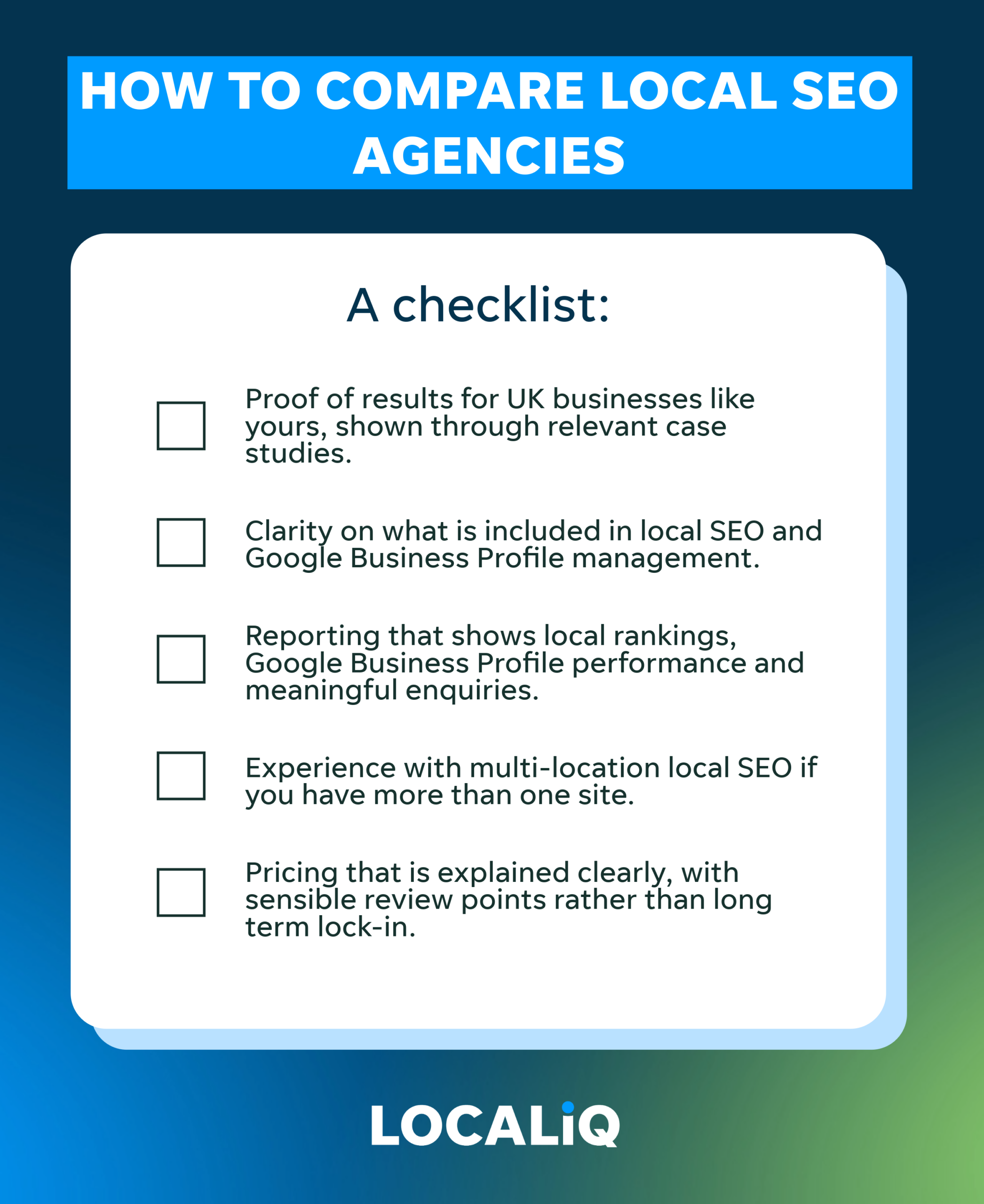
A checklist: how to compare local SEO agencies
If you want a quick way to compare different local SEO agencies, you can use this simple checklist as a summary of the key things to look for.
- Proof of results for UK businesses like yours, shown through relevant case studies.
- Clarity on what is included in local SEO and Google Business Profile management.
- Reporting that shows local rankings, Google Business Profile performance and meaningful enquiries.
- Experience with multi-location local SEO if you have more than one site.
- Pricing that is explained clearly, with sensible review points rather than long term lock-in.
You can keep this list to hand when you speak to potential agencies, so you can quickly tick off who meets your criteria and who does not.
Why work with a local SEO agency that has a UK presence?
For local SEO in particular, working with an agency that has a real UK presence can make a noticeable difference. A team that lives and works in the UK will naturally better understand local search behaviour, regional differences and the realities of competing in British towns and cities.
LOCALiQ has multiple locations across the UK, which means you are working with people who understand both national trends and local nuances in your area. This matters when it comes to shaping your keyword strategy, tailoring your Google Business Profiles and planning campaigns around UK-specific seasonality and events.

Related Articles

Proof That Digital PR Works: 3 Standout Results Delivered by LOCALiQ UK

What Makes a Good Website? Lessons from an Award-Winning Agency

The Truth About Rising CPCs: Insights from Hundreds of UK Campaigns

LOCALiQ Shortlisted in 4 Categories at the 2026 UK Agency Awards

How to Identify Your Target Audience: A Complete Guide for UK Businesses